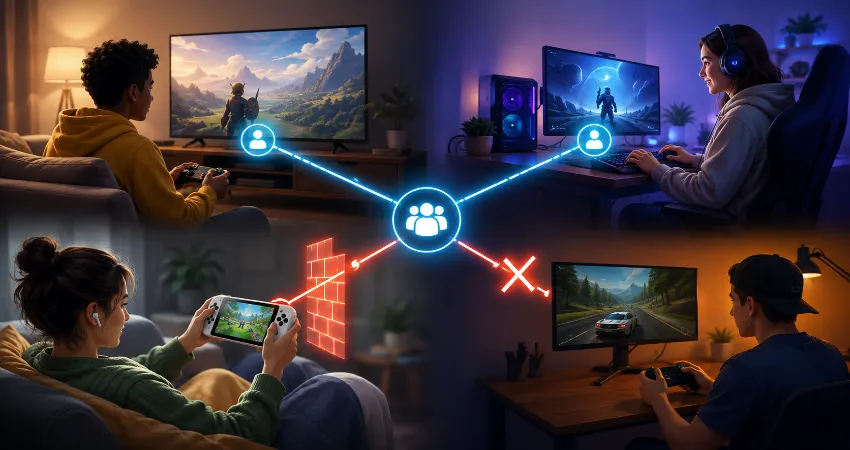
Gaming has changed dramatically over the last decade. Players no longer choose a console only based on hardware power or exclusive games. Online communities, friends lists, and shared experiences have become major parts of modern gaming. However, many players still face a confusing problem: a friend owns the same game, but they cannot join because they are playing on a different console.
Cross-play was introduced to solve this exact problem by allowing players on different platforms to play together. While the idea sounds simple, the technology behind it is much more complicated. A game must support multiple systems, networks, accounts, security standards, and technical requirements before cross-platform multiplayer can work smoothly.
Understanding why cross-play works in some games but fails in others helps players make better decisions when choosing games and platforms. This guide explains how cross-play works, why it is limited, and what factors decide whether your friends on another console can join your online session.
What Is Cross-Play In Gaming?
Cross-play, also called cross-platform play, is a feature that allows players using different gaming platforms to play together in the same online match or cooperative session. For example, a player on a console may be able to join a friend using another console or a PC if the game supports that connection.
Traditional online gaming usually kept players separated by platform. Console networks were often isolated because each system used its own online infrastructure, account systems, and security rules. Cross-play removes some of these barriers by creating a shared multiplayer environment.
How Does Cross-Play Actually Work?
From a technical perspective, cross-play requires much more than simply connecting two devices. Game developers must create systems that allow different platforms to communicate with each other while keeping gameplay balanced and secure.
Many modern games use their own account systems instead of relying only on console accounts. This allows a player profile, progress, friends list, and achievements to move between supported platforms. The game server acts as a bridge between different devices and manages player connections.
Developers also need to make sure that gameplay functions correctly across hardware differences. A PC player with different control options, a console player using a controller, and another player on a different console must all interact within the same rules.
Why Can’t All Games Support Cross-Play?
The biggest misunderstanding about cross-play is that it is only a button developers need to activate. In reality, adding cross-play can require major changes to a game’s online structure. Some games were built years before cross-platform gaming became common, making the feature difficult or impossible to add later.
Older games may have separate server systems for each platform. Combining these systems requires significant development work, testing, and security improvements. In some cases, the original design of the game does not support a shared environment.
Console Companies And Cross-Platform Restrictions
Another important factor is that console manufacturers have their own online policies. Each platform owner manages its network, security standards, user accounts, and approval processes. A game developer must meet the requirements of every platform involved.
Historically, some companies were cautious about cross-play because they wanted to protect their online ecosystems. Today, cross-play is more widely accepted because players increasingly expect flexible multiplayer experiences. However, platform agreements and technical rules can still affect availability.
The Difference Between Cross-Play, Cross-Progression, And Cross-Save
Many players confuse cross-play with other connected features. Cross-play means players on different platforms can play together. Cross-progression means your character level, items, or achievements can continue across platforms. Cross-save means your saved game data can be transferred or synchronized between systems.
A game may support one feature without supporting the others. For example, a game might allow console and PC players to play together but keep separate progress systems. Understanding these differences prevents confusion when choosing where to play.
Why Some Games Disable Cross-Play Between Certain Platforms?
Even when a game supports cross-play, developers may limit connections between specific platforms. One common reason is gameplay balance. Different platforms can have different control methods, performance levels, or technical advantages.
Developers may also consider player experience. A competitive game might separate certain platforms to ensure matches feel fair. Security concerns, account management issues, or server limitations can also influence these decisions.
The Role Of Game Developers In Cross-Play Support
Game developers are responsible for building the systems that make cross-play possible. They decide whether the feature fits the game’s design, budget, and long-term plans.
In my experience studying gaming platforms and online systems, the most successful cross-play implementations usually come from developers who design multiplayer infrastructure with flexibility from the beginning. Adding cross-play after launch is often much harder than building it into the original foundation.
How Players Can Check If A Game Supports Cross-Play?
Before buying a game or inviting friends, players should check the official game information for cross-play support. Many developers clearly list supported platforms and explain whether features such as shared accounts or cross-progression are available.
Players should also confirm that everyone is using compatible game versions. Sometimes different editions, regions, or updates can prevent players from joining the same session even when cross-play exists.
The Future Of Cross-Platform Gaming
Cross-play is becoming an expected feature in modern multiplayer games. As gaming communities become more connected, players want fewer restrictions between platforms. Developers are increasingly designing online systems that support wider compatibility from launch.
The future of gaming will likely include more connected experiences, but complete cross-platform support will still depend on technology, business decisions, and game design choices. Cross-play is not a universal solution, but it represents an important step toward a more open gaming environment.
Frequently Asked Questions About Cross-Play
1. What does cross-play mean in video games?
Cross-play means players using different gaming platforms can play together in the same online game. For example, players on separate consoles or a PC may join the same multiplayer match if the developer has enabled the feature. It removes the traditional limitation that only players on the same system can connect.
2. Why does my friend have the same game but cannot join me?
Having the same game does not always guarantee compatibility. The game may not support cross-play, the platforms may not be connected, or players may be using different versions. Account settings, regional restrictions, or missing updates can also prevent multiplayer connections.
3. Does every multiplayer game have cross-play?
No. Cross-play depends on the developer, game design, and platform support. Some games are created with cross-platform multiplayer from the beginning, while others remain limited to individual platforms because of technical or development challenges.
4. Is cross-play available between consoles and PC?
Many games support console and PC cross-play, but it is not automatic. Developers decide which platforms can connect based on technical requirements, gameplay balance, and online infrastructure. Players should always check the game’s official support information.
5. Can cross-play affect gameplay fairness?
Yes, cross-play can create balance challenges because different platforms may use different controls and hardware. Developers often use settings, matchmaking options, or platform preferences to create a better experience for all players.
6. Does cross-play mean I can transfer my progress anywhere?
No. Cross-play only allows players to play together. Moving your progress between platforms requires separate features such as cross-progression or cross-save. A game may support multiplayer connections without allowing account transfers.
7. Why do some popular games still not support cross-play?
Some games were built with separate online systems that are difficult to combine. Others may face security concerns, platform limitations, or development costs. Adding cross-play after a game’s release can require significant technical changes.
8. Can I turn cross-play on or off?
Many games provide a cross-play option in their settings menu. Players may disable it if they prefer playing only with users on the same platform. However, some games require cross-play to remain enabled because their matchmaking system depends on it.
9. Do all versions of a game support the same cross-play features?
No. Different versions may have different capabilities depending on hardware, updates, and developer decisions. A newer console version may support features that an older version does not have.
10. Will cross-play become standard for future games?
Cross-play is likely to become more common because players value connected communities. However, it will continue to depend on technical design, platform agreements, and developer choices. Not every game will offer complete cross-platform support.
Conclusion
Cross-play has changed how players connect, but it is not as simple as allowing different consoles to communicate. Behind every successful cross-platform experience are complex technical systems, platform agreements, and careful game design decisions. When friends cannot join each other, the reason is usually related to these hidden challenges rather than a simple limitation.
As gaming technology continues to improve, cross-play will likely become a bigger part of online gaming. Understanding how it works helps players choose games wisely and enjoy smoother multiplayer experiences with their communities.